Overview of Manas National Park
Manas National Park is, without question, one of the most extraordinary and most multiply-designated protected areas on Earth — a landscape that simultaneously holds six of the highest possible national and international conservation designations: UNESCO Natural World Heritage Site, Project Tiger Reserve, Biosphere Reserve (under UNESCO's Man and Biosphere Programme), Project Elephant Reserve, National Park, and Important Bird Area. No other protected area in India, and very few anywhere in the world, carries this combination of designations — a fact that reflects Manas's genuinely exceptional ecological significance and the extraordinary diversity and density of threatened species it shelters.
Located in the Himalayan foothills of Assam, in the districts of Chirang, Baksa, Kokrajhar, Udalguri, and Darrang in the Bodo Territorial Region (BTR) of Assam, Manas National Park forms the core zone (500 sq km) of the larger Manas Biosphere Reserve (2,837 sq km total, extending from the Sankosh River in the west to the Dhansiri River in the east). To the north, it borders the Royal Manas National Park of Bhutan — creating one of the most significant international transboundary conservation landscapes in Asia, where the Manas River itself serves as the international boundary between India and Bhutan, flowing through the shared protected area of both countries. The total protected area complex, including both Indian and Bhutanese components, represents one of the finest remaining subtropical forest-grassland wilderness systems in the Eastern Himalayan biodiversity hotspot.
The park is named after the Manas River — a major tributary of the Brahmaputra — which flows through the west of the park and splits into two channels (the Bwrsi and the Bholkaduba) as it reaches the plains. The river is itself named after a local serpent goddess, the Manasa Devi, investing the park's name with deep cultural and mythological resonance. Five other smaller rivers (including the Beki) also flow through the national park, creating the extraordinary network of riverine habitats — shifting channels, sand banks, alluvial grasslands, riverine forest — that accounts for a significant proportion of Manas's legendary wildlife spectacle.
Manas has one of the most dramatic conservation histories of any protected area in India. Declared a Game Refuge in 1928 (having previously been a hunting ground of the royal families of Cooch Behar and Gauripur), it became India's first tiger reserve under Project Tiger in 1973 (the fifth in India overall), a UNESCO World Heritage Site in 1985, and a Biosphere Reserve in 1989. In 1992, UNESCO made the alarming decision to place Manas on the List of World Heritage in Danger — triggered by the devastating consequences of the Bodo militant insurgency, during which widespread poaching decimated the park's wildlife populations (rhinos were virtually extirpated, tiger numbers collapsed, and infrastructure was destroyed). What followed was one of the most compelling conservation recovery stories in the world: through the eventual resolution of the political conflict, the rehabilitation of former poachers as eco-tourism guides through the Manas Maozigendri Ecotourism Society, the extraordinary efforts of the Bodo community, Forest Department, and conservation organisations, Manas was removed from the List of World Heritage in Danger on 21 June 2011 and commended for its conservation recovery efforts — a vindication of human commitment to wildlife in the face of the most extreme adversity.
Geography, Topography & Ecology
Manas National Park lies on a wide, low-lying alluvial terrace spreading out below the foothills of the outer Himalaya — a landscape at the transition point between the Himalayan mountain system and the Brahmaputra Valley floodplain, where the Bhabar (porous, coarse alluvial) and Terai (fine alluvial, seasonally waterlogged) geological formations create the exceptional soil and hydrological conditions that underpin the park's extraordinary biodiversity.
Approximately 50% of the park is covered by alluvial semi-evergreen grasslands — the classic tall-grass savannah of the Terai ecosystem, dominated by Elephant Grass (Saccharum spontaneum and Saccharum naranga), which forms towering stands exceeding 4–5 metres in height and creates the defining visual character of the Manas landscape. This grassland matrix is interspersed with mixed moist and dry deciduous forest, riverine dry deciduous forest (at early successional stages continually refreshed by flooding), and — in the northern parts of the park — Sub-Himalayan light alluvial semi-evergreen forests and East Himalayan mixed moist and dry deciduous forests that represent the transition toward the Himalayan montane zone. The overall vegetation is classified within the Brahmaputra Valley semi-evergreen forests ecoregion — a globally significant habitat type found only in northeastern India and parts of Bhutan and Bangladesh.
The bedrock of the savanna area in the north is limestone and sandstone; the southern grasslands stand on deep fine alluvium. This geological contrast, combined with the extraordinary altitudinal range possible within a relatively small area (from the Brahmaputra floodplain to the Himalayan foothills), generates one of the richest and most diverse habitat mosaics in all of Asia.
The Conservation Recovery — From World Heritage in Danger to Recovery Model
The story of Manas's recovery from its "World Heritage in Danger" status between 1992 and 2011 is one of the most inspiring conservation narratives in India's modern wildlife management history, and deserves particular attention as a model for the relationship between political stability, community engagement, and ecological recovery.
During the height of the Bodo militant insurgency (1988–2003), the park's wildlife suffered catastrophic losses: the Indian one-horned rhinoceros was essentially poached to extinction within Manas (reducing from a substantial population to near zero), tiger numbers collapsed, and anti-poaching infrastructure was destroyed or abandoned. Forest officials were unable to effectively patrol the area due to active militant activity. The scale of the ecological damage was such that UNESCO felt compelled to declare the site "In Danger" — an extraordinary step rarely taken for a protected area, reflecting the gravity of the situation.
What turned the situation around was a combination of factors that came together in the 2003–2011 period: the political resolution of the Bodo conflict and the establishment of the Bodoland Territorial Council (BTC) governance structure, which gave Bodo communities meaningful administrative authority and accountability; the innovative rehabilitation of former poachers as wildlife guides and eco-tourism operators through the Manas Maozigendri Ecotourism Society — transforming the park's most dangerous adversaries into its most motivated guardians; the reintroduction of Indian one-horned rhinoceros beginning in 2007 (with rhinos translocated from Pobitora Wildlife Sanctuary); and sustained investment in anti-poaching infrastructure and community engagement programmes. The decision by UNESCO to remove Manas from the Danger List in 2011 — specifically commending the conservation efforts — was a global recognition of this extraordinary turnaround.
Flora of Manas National Park
The botanical richness of Manas is as remarkable as its faunal diversity. A total of 543 plant species have been recorded from the core zone alone, including 89 tree species, 49 shrubs, 37 undershrubs, 172 herbs, 36 climbers, 15 orchid species, 18 fern species, and 43 grass species — a flora of exceptional diversity for a predominantly lowland grassland-forest ecosystem. The high soil fertility and natural regenerative capacity of the alluvial floodplain soil means that the vegetation has extraordinary self-sustaining properties.
Dominant tree species in the mixed moist deciduous zones include Anthocephalus chinensis (Kadam), Aphanamixis polystachya, Syzygium species, and Bombax ceiba (Silk Cotton/Semal). In the semi-evergreen forests of the northern parts: Dipterocarps (notable for this southern extent of their range), Artocarpus, Lagerstroemia, and Ficus species dominate. Bamboo (Dendrocalamus and Bambusa species) and cane form important understory communities. The grasslands are characterised by the iconic tall elephant grasses — Saccharum spontaneum, Saccharum naranga, Imperata cylindrica (Kans grass) — along with a diverse community of shorter grasses, sedges, and seasonal herbs that change with the wet and dry seasons.
Wildlife: Fauna of Manas National Park
The Pygmy Hog — The World's Last Wild Population
The Pygmy Hog (Porcula salvania) — the world's smallest wild pig, measuring just 25–30 cm in height and weighing 6–9 kg — holds a uniquely historic and globally significant relationship with Manas National Park: this is the only place on Earth where the pygmy hog survives in the wild. Once widely distributed across the Himalayan foothills from Nepal to northeast India, the pygmy hog was believed extinct for decades until its rediscovery in 1971 in the Barnadi Wildlife Sanctuary of Assam. A captive breeding programme launched in the 1990s by the Durrell Wildlife Conservation Trust and EcoSystems India has successfully bred and released pygmy hogs back into Manas and other suitable habitats. In 2024, 9 additional pygmy hogs were released into the wild in Manas, incrementally strengthening the only free-ranging population of this Critically Endangered species anywhere on Earth. The pygmy hog's survival is inextricably linked to the conservation of Manas's tall grassland habitat.
Wild Water Buffalo — India's Purest Strain
The Wild Water Buffalo (Bubalus arnee) at Manas National Park holds a globally unique distinction: it is believed to represent the only remaining pure strain (genetically uncontaminated by domestic cattle hybridisation) of wild water buffalo surviving in India. This genetic purity — maintained by the geographical isolation of Manas's buffalo population from domestic cattle — gives the Manas buffalo extraordinary conservation value beyond their ecological importance. A spectacular animal reaching up to 3 metres in length and 1,200 kg in weight, wild water buffalo are among the largest bovids in the world. Large herds are regularly sighted on the park's alluvial grasslands and riverbanks.
Golden Langur — The Endemic Primate
The Golden Langur (Trachypithecus geei) is one of India's most beautiful and most endangered primates — a spectacularly golden-coated leaf monkey found only in a narrow belt of forest between the Manas River and the Black Mountains of Bhutan. Manas National Park is one of the most important strongholds for this species, which was formally described to science only in 1956 by E.P. Gee (the Assam naturalist after whom it is named). The combination of its extremely restricted range and its charismatic appearance makes the golden langur one of Manas's most celebrated wildlife attractions.
Indian One-Horned Rhinoceros
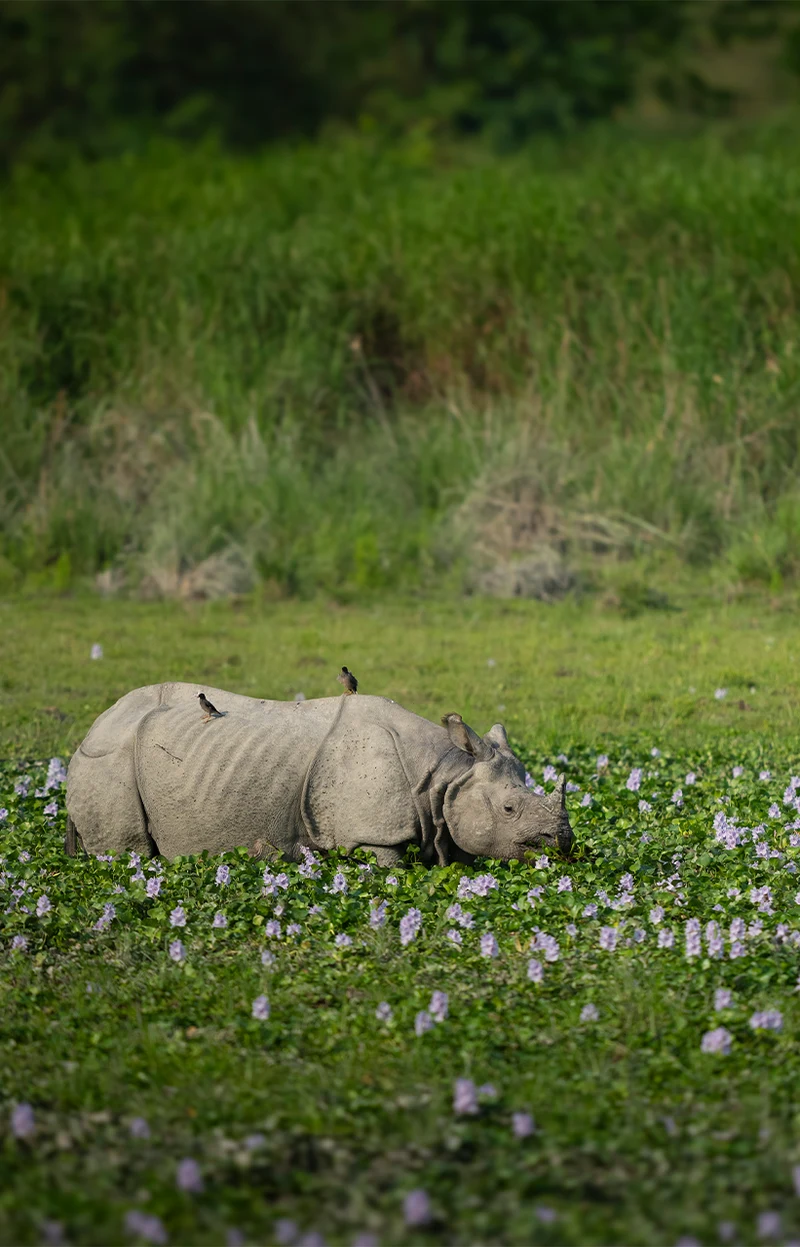
The Greater One-Horned Rhinoceros (Rhinoceros unicornis) was reintroduced into Manas in 2007 after the species was essentially poached out during the insurgency period. The reintroduction programme, involving animals translocated from Pobitora Wildlife Sanctuary, has been successful: the rhino population is recovering, and sightings — particularly in the Bansbari zone near the Manas River — are now a realistic expectation for visitors.
Complete Mammal Roster — 55+ Species
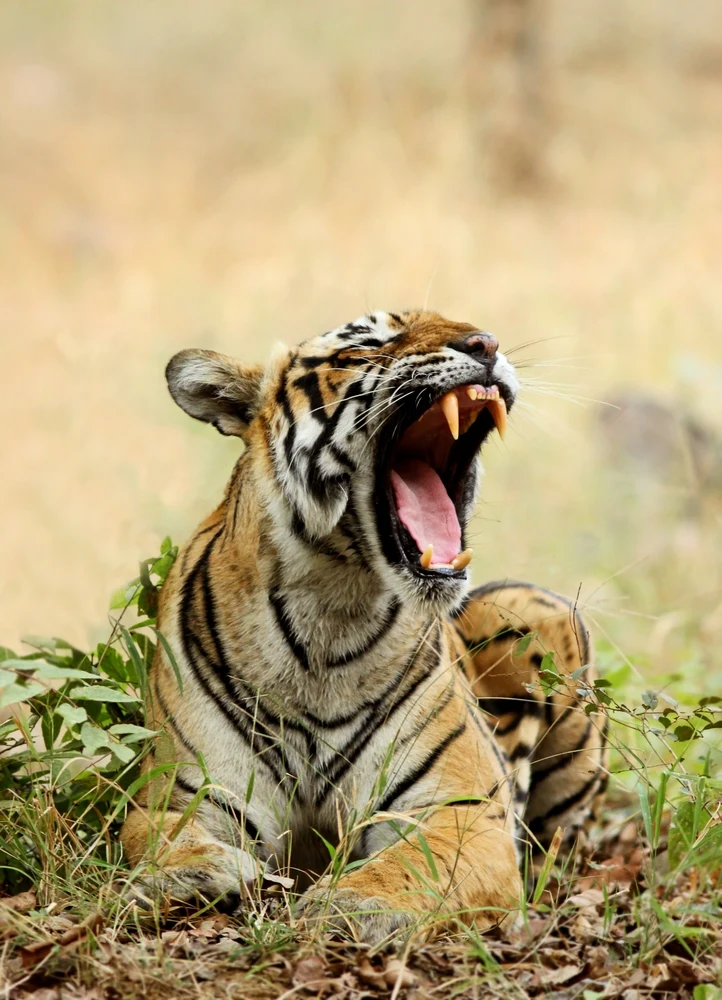
- Bengal Tiger (Panthera tigris tigris) — population has tripled in the last decade; apex predator
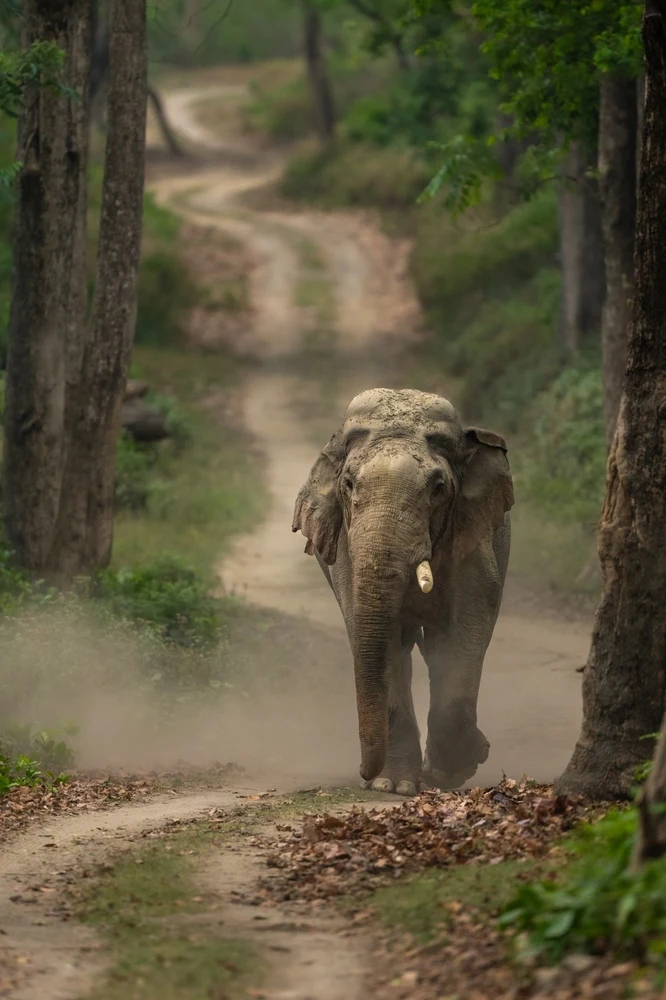
- Indian Elephant (Elephas maximus) — large herds; part of the Chirang-Ripu Elephant Reserve
- Indian Leopard (Panthera pardus fusca) & Clouded Leopard (Neofelis nebulosa)
- Asian Golden Cat, Jungle Cat, Leopard Cat, Marbled Cat, Fishing Cat — five wild cat species
- Dhole (Indian Wild Dog, Cuon alpinus)
- Sloth Bear (Melursus ursinus)
- Hoolock Gibbon (Hoolock hoolock) — India's only ape; arboreal specialist of the eastern forests
- Hispid Hare (Caprolagus hispidus) — Critically Endangered; one of the rarest lagomorphs on Earth
- Assam Roofed Turtle (Pangshura sylhetensis) — Endangered endemic; Manas is a key refuge
- Smooth-coated Otter (Lutrogale perspicillata)
- Chinese Pangolin (Manis pentadactyla), Indian Pangolin (Manis crassicaudata) — both Critically Endangered
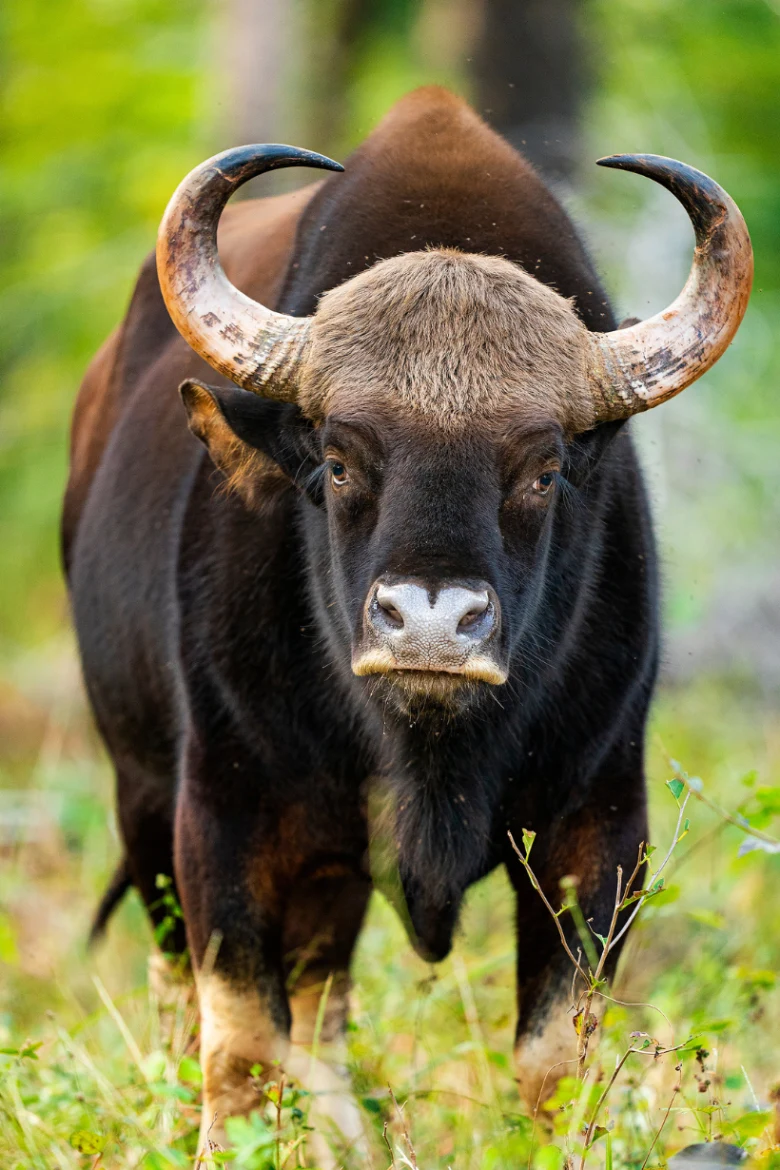
- Gaur (Indian Bison), Sambar Deer, Barking Deer, Hog Deer, Swamp Deer (Barasingha), Chital
- Large Indian Civet, Spotted Linsang, Yellow-throated Marten, Black Giant Squirrel
Avifauna — 450+ Species Including Bengal Florican
Manas is one of the finest bird sanctuaries in India — an Important Bird Area (IBA) with 450+ recorded species, of which 26 are globally threatened. The Bengal Florican (Houbaropsis bengalensis) — one of the world's most critically endangered bustards, with fewer than 1,000 individuals remaining globally — finds its largest population at Manas, where the alluvial grasslands provide the breeding habitat that this species requires and cannot find elsewhere. Great Hornbill, Wreathed Hornbill, Red-headed Vulture (Critically Endangered), Fishing Eagle, and 312 other bird species are recorded. Brahminy Ducks, migratory waterfowl, and an extraordinary range of forest and grassland specialists make Manas a premier destination for ornithologists and birdwatchers.
Safari Options at Manas National Park
Manas National Park has three main tourism zones, each offering different habitats and wildlife focus:
Bansbari Zone (Central — Most Popular)
The primary tourism zone and the main entry point for most visitors. The landscape here is a spectacular mix of alluvial grasslands, forest patches, and riverbanks — providing the highest probability of encountering elephants, rhinos, wild buffaloes, and the park's forest mammals. Most jeep safaris, elephant rides, and other activities operate from the Bansbari Range. Bansbari Lodge (operated by the Assam Tourism Development Corporation) is the principal eco-lodging option.
Panbari Zone (Western)
A predominantly forested zone with excellent birding and good mammal sightings. The Panbari Reserve Forest adds depth and biodiversity to this section. River rafting and boat safaris on the Manas River are available from this zone, providing excellent views of the riverbank wildlife and the Bhutan hills.
Bhuyanpara Zone (Eastern)
A less-visited and more remote zone offering excellent opportunities for undisturbed wildlife observation. This zone has the highest probability for golden langur sightings in the transitional forest-grassland habitat.
Jeep Safari
Open jeep (gypsy) safaris are the primary activity, accommodating 6 tourists per vehicle with a trained guide and driver. Safaris operate in the early morning (6:00–10:00 AM) and late afternoon (2:00–6:00 PM) slots. The park is generally open from November to April; closed during monsoon (June–September). Advance online booking recommended through the official Assam Forest Department portal.
Elephant Safari
Elephant safaris offer unparalleled access to tall grassland habitats that are inaccessible to jeeps — particularly important for rhino and wild buffalo observation at close range. The Bansbari zone has dedicated elephant safari starting points. Safari mahouts are trained members of the local Bodo community, adding a cultural dimension to the wildlife experience.
River Rafting & Boat Safari
River rafting and boat safaris on the Manas River — particularly in the Panbari zone — provide a unique water-based perspective on the park's wildlife. The riverbanks are productive for waterbird sightings, and the view of the Bhutan hills across the river creates an extraordinary transboundary landscape experience.
Bodo Village Visits
Visiting the Bodo villages adjacent to the park — experiencing the Bodo people's traditional weaving, cuisine, and culture — is an enriching complement to the wildlife experience. The Manas Maozigendri Ecotourism Society facilitates these cultural visits and employs former poachers as guides, adding a powerful conservation-community narrative to every visit.
How to Reach Manas National Park
By Air
Lokpriya Gopinath Bordoloi International Airport, Guwahati (IATA: GAU) — approximately 140–170 km from the park (approximately 4–5 hours by road). Guwahati is connected to Delhi, Mumbai, Kolkata, Bengaluru, and other major cities. From Guwahati Airport, hire a taxi directly to Barpeta Road or Bansbari (the park entry points).
By Rail
Barpeta Road Railway Station — approximately 40 km from the Bansbari entry gate (approximately 1.5 hours). Well-connected to Guwahati and the broader northeast rail network. From Barpeta Road station, hire a taxi to the park. Guwahati Railway Station (140 km) is an alternative for those with broader national connectivity.
By Road
Key distances: Guwahati — 140–170 km (4 hours via NH-27/NH-31); Barpeta Road — 40 km (1.5 hours); Bongaigaon — 60 km (2 hours); Tezpur — approximately 200 km (5 hours). NH-27 (former NH-31) is the primary route from Guwahati toward Barpeta Road; from Barpeta Road, proceed north toward Bansbari (Manas National Park). Regular ASTC (Assam State Transport Corporation) buses connect Guwahati to Barpeta Road.
Best Time to Visit
November to April (Open Season — Best Overall)
Manas is open from November to April. The post-monsoon months (November–January) bring lush green forests, comfortable temperatures (10–25°C), and active wildlife — particularly elephant and rhino sightings near the river. February–March is excellent for tiger sightings as the park trails are well-maintained. March–April: summer approach brings wildlife to water sources — particularly productive for rhinos, buffalo, and elephants near the Manas River bank. The Bengal Florican display season is March–April.
June to September (Monsoon — Closed)
The park closes during the monsoon season as the entire floodplain becomes inundated by Brahmaputra floodwaters. The alluvial grasslands regenerate during this period, preparing for the next season's wildlife spectacle.
Entry Fees & Timings
- Park open: November to April (exact dates vary; check with park management)
- Safari timings: 6:00–10:00 AM (morning); 2:00–6:00 PM (afternoon)
- Entry fee: Approximately Rs. 50–150 per person for Indians; higher for foreigners (confirm current rates at park or via official Assam Tourism website)
- Jeep hire: Approximately Rs. 2,000–3,500 per safari vehicle
- Elephant safari: Confirm current rates at the Bansbari Range entry point
- Online booking: Assam Forest Department portal; advance booking strongly recommended for peak season (December–February)
Accommodation Options
- Bansbari Lodge (ATDC — Assam Tourism Development Corporation): The principal eco-tourism lodge at the Bansbari zone — operated by the Assam Tourism Development Corporation and the Manas Maozigendri Ecotourism Society. Excellent location for early-morning wildlife observation.
- Mathanguri Forest Rest House (inside park): Historic forest rest house on the north bank of the Manas River, directly facing the Bhutan hills. One of the most atmospheric wildlife accommodations in India — the view across the river to Royal Manas NP in Bhutan is unforgettable. Limited rooms; advance booking essential through the park office.
- Musa Jungle Retreat: Private eco-resort near the park with excellent naturalist-guided experiences.
- The Smiling Tusker Elephant Camp, Camp Buffalo Retreat: Community and private lodges near the Bansbari zone.
- Florican Jungle Cottage, Birina Eco Camp, Sikhri Resort: Range of eco-lodging options near the park periphery.
- Manas Motel Tourist Lodge (Manas Motel Eco-Society): Budget-friendly option near the park entrance with home-cooked food.
- Barpeta Road town (40 km): Basic hotels for budget travellers.
Nearby Attractions
Royal Manas National Park, Bhutan (across the Manas River)
The transboundary Royal Manas National Park in Bhutan — visible across the Manas River from the Mathanguri rest house — shares the same ecological landscape as Manas NP. Cross-border visits require Bhutan visa and travel authorisations; coordinate with Bhutan tourism operators.
Kaziranga National Park (~240 km east)
India's most celebrated rhino sanctuary and UNESCO World Heritage Site, Kaziranga is the natural companion to a Manas visit for a comprehensive Northeast India wildlife circuit.
Pobitora Wildlife Sanctuary (~130 km east via Guwahati)
The wildlife sanctuary that provided Manas's reintroduction rhinos — Pobitora has the world's highest density of Indian one-horned rhinoceros per square kilometre, in a compact 39 sq km landscape near Guwahati.
Guwahati City (~140 km south)
Assam's capital city — home to the ancient Kamakhya Temple (one of India's most sacred Shakti pilgrimage sites), the Umananda Temple on Peacock Island in the Brahmaputra, the Assam State Museum, and the IITG campus. An excellent urban complement to the wildlife experience.
Conservation Status & Significance
Manas National Park stands as perhaps the most compelling case study in the world for the intersection of political conflict, community-based conservation, and wildlife recovery. The transition from "World Heritage in Danger" (1992) to a site commended for conservation efforts (2011) — achieved through the transformation of former poachers into eco-tourism guides, the political empowerment of the Bodo community, and sustained conservation investment — is a template that wildlife managers across the globe study and reference.
The park's global significance is anchored by its role as the sole wild refuge for the pygmy hog, as the home of the world's purest wild water buffalo strain, as a critical stronghold for the Bengal florican (the world's most endangered bustard species), and as the only transboundary protected area in this part of the Eastern Himalayas. Its six simultaneous international and national designations — unprecedented for an Indian park — reflect the genuinely extraordinary concentration of conservation value within this single landscape.
Travel Tips for Manas National Park
- Book accommodation and safaris well in advance for December–February — the peak season fills up months ahead, particularly for the atmospheric Mathanguri Forest Rest House.
- Request an ex-poacher guide through the Manas Maozigendri Ecotourism Society — their ecological knowledge, personal redemption story, and intimate familiarity with the park provide an unparalleled depth of experience.
- For bengal florican observation, visit in March–April and request the grassland circuits in the Bansbari zone — dawn and dusk are most productive.
- Elephant safaris provide the best access to tall grassland zones where rhinos and wild buffaloes concentrate — book these on arrival at the Bansbari range entry.
- Allow at least 3 nights at Manas — the park's scale and habitat diversity reward extended visits significantly more than a quick overnight trip.
- Visit the Bodo villages adjacent to the park — the cultural experience of traditional Bodo weaving and cuisine is deeply enriching and directly supports the community conservation model.
Frequently Asked Questions (FAQ) - Manas National Park
How many UNESCO designations does Manas National Park have?
Manas holds six national and international designations: UNESCO Natural World Heritage Site (1985), Project Tiger Reserve (1973), UNESCO Biosphere Reserve (1989), Elephant Reserve/Chirang-Ripu Elephant Reserve (2003), National Park (1990), and Important Bird Area. This combination of six simultaneous designations is essentially unmatched among Indian protected areas.
What happened to Manas during the Bodo insurgency?
During the Bodo militant insurgency (primarily 1988-2003), widespread poaching essentially extirpated the Indian one-horned rhinoceros from Manas, collapsed the tiger population, and destroyed park infrastructure. UNESCO placed Manas on its World Heritage in Danger list in 1992. Following the political resolution and the rehabilitation of former poachers as eco-guides, the park was removed from the Danger list in 2011 - one of the world's most celebrated conservation recovery stories.
Is the pygmy hog really found only at Manas?
Yes. The Pygmy Hog (Porcula salvania) - the world's smallest wild pig - survives in the wild only at Manas National Park and a small number of other northeast Indian protected areas where captive-bred individuals have been released. Once widely distributed across the Himalayan terai, the species was thought extinct for decades before its 1971 rediscovery. Manas remains the core wild refuge for this Critically Endangered species.
What is the wild water buffalo of Manas?
The Wild Water Buffalo (Bubalus arnee) at Manas is believed to be the only genetically pure strain of wild water buffalo surviving in India - meaning these animals have not been contaminated by hybridisation with domestic cattle (a serious conservation concern for wild buffalo populations elsewhere). Manas's pure-strain buffalo population is thus of exceptional genetic and conservation importance.
How do I reach Manas National Park from Guwahati?
Manas is approximately 140-170 km from Guwahati (4-5 hours by road via NH-27/NH-31). Drive toward Barpeta Road (approximately 140 km from Guwahati), then north to Bansbari (40 km from Barpeta Road). Alternatively, take a train from Guwahati to Barpeta Road Station and hire a taxi. Regular ASTC buses also connect Guwahati to Barpeta Road.
What is the Mathanguri Forest Rest House?
The Mathanguri Forest Rest House is a historic government-managed accommodation located on the north bank of the Manas River - directly facing the Bhutan hills of Royal Manas National Park across the river. It is considered one of the most atmospheric and scenically extraordinary wildlife accommodations in India. Limited rooms are available; advance booking through the Manas National Park office is essential.
What makes the Bengal Florican special at Manas?
The Bengal Florican (Houbaropsis bengalensis) - a Critically Endangered bustard with fewer than 1,000 individuals remaining globally - finds its largest known population in Manas National Park. The park's extensive alluvial grasslands provide the breeding habitat this species requires and cannot find at most other Indian protected areas. March-April is the best season for florican observation.
Which zone is best for wildlife at Manas?
The Bansbari Central Zone is the most productive and most developed for tourism, with the highest probability of elephants, rhinos, wild buffaloes, and forest mammals. The Bhuyanpara Eastern Zone is best for golden langurs. The Panbari Western Zone offers excellent birding and river-based wildlife observation. For the most comprehensive experience, plan visits across at least two zones.
Is Manas National Park open year-round?
No. Manas is open from November to April and closed during the monsoon season (June-September) when the floodplain inundates. May is a transition month - check with the park office for exact opening and closing dates each year as they may vary.
How many bird species are found at Manas?
Manas has 450+ recorded bird species, of which 26 are globally threatened. The most notable is the Bengal Florican (Critically Endangered) - with Manas supporting its largest known wild population. Other significant species include Great Hornbill, Wreathed Hornbill, Red-headed Vulture, Fishing Eagle, Brahminy Duck, and hundreds of forest, grassland, and waterbird species.