1. Bandipur Tiger Reserve
Mysore & Chamarajanagar Districts, Karnataka
Area: 912.04 sq. km
Established: 1973 (one of India's 9 original Tiger Reserves)
Bandipur Tiger Reserve occupies one of the most ecologically significant locations in all of India - the confluence of the Western and Eastern Ghats in the Mysore and Chamarajanagar districts of Karnataka. One of the nine original reserves launched under Project Tiger in April 1973 by Prime Minister Indira Gandhi - when only 12 tigers were counted here - Bandipur today shelters 173 tigers as per the 2022 census, a turnaround that stands as one of conservation's great achievements. The reserve forms part of the largest contiguous wildlife habitat in South Asia: the Bandipur-Nagarhole-Mudumalai-Wayanad-Sathyamangalam landscape, collectively harbouring the world's single largest wild tiger population of approximately 382 individuals. The landscape is also home to one of India's largest Asian elephant populations. Bandipur's forests - dry deciduous teak, rosewood, and sandalwood giving way to moist deciduous vegetation - shelter leopards, dholes, sloth bears, gaur, sambar, four-horned antelope, and over 350 bird species. The legendary Kabini River borders the reserve to the north, attracting spectacular aggregations of elephants near its waters every summer.
2. Nagarhole Tiger Reserve (Rajiv Gandhi National Park)
Mysore & Kodagu Districts, Karnataka
Area: 643 sq. km (core); ~870 sq. km (total)
Established: 1955 (Sanctuary); 1988 (National Park); 1999 (Tiger Reserve)
Nagarhole - meaning 'snake streams' in Kannada - is Karnataka's most visited wildlife destination and one of India's premier tiger and elephant reserves. Located in the Mysore and Kodagu districts, it forms the north-western anchor of the magnificent five-state wildlife complex that also includes Bandipur, Mudumalai, Wayanad, and Sathyamangalam. Once the private hunting ground of the Wodeyar Maharajas of Mysore, the park was declared a national park in 1988 and a tiger reserve in 1999. The Kabini and Nagarhole rivers thread through its forests - and the Kabini reservoir, which sits at the park's southern boundary, is renowned for attracting enormous herds of elephants during summer, when they emerge from the forest to drink and bathe in spectacular concentrations. The park shelters Bengal tigers, leopards, dholes, gaur, sambar, barking deer, sloth bears, and over 270 bird species. The dense riverine forests of the Kabini area offer some of the most reliably rewarding wildlife safaris in southern India.
3. Bhadra Tiger Reserve
Chikmagalur District, Karnataka
Area: 492.46 sq. km
Established: 1974 (Sanctuary); 1998 (Tiger Reserve)
Bhadra Tiger Reserve is situated in the misty Sahyadri hill ranges of the Western Ghats in Chikmagalur district, Karnataka - one of the state's most scenic and ecologically rich landscapes. Designated a tiger reserve in 1998 under Project Tiger, it covers 492.46 sq. km of varying forest types including evergreen, semi-evergreen, moist deciduous, and dry deciduous vegetation. The Bhadra River - a major tributary of the Tungabhadra - originates within the reserve and is central to its ecology. The Bhadra Wildlife Sanctuary provides the physical barrier between the coastal belt and the hinterland of Karnataka. Wildlife includes Bengal tigers, leopards, elephants, gaur, sambar, barking deer, giant flying squirrels, and rare birds like the Malabar trogon and Malabar pied hornbill. Camera trap surveys have revealed a healthy tiger population recovering steadily. The reserve is contiguous with the Kudremukh National Park forests to the west, creating a vital wildlife corridor within the Western Ghats.
4. Kali Tiger Reserve (Dandeli-Anshi Tiger Reserve)
Uttara Kannada District, Karnataka
Area: 1,074.21 sq. km
Established: 1956 (Sanctuary); 2007 (Tiger Reserve)
Kali Tiger Reserve, officially known as Dandeli-Anshi Tiger Reserve and also marketed as the Kali Tiger Reserve after the Kali River that flows through it, is Karnataka's largest protected area covering 1,074.21 sq. km in the Uttara Kannada district near the Goa border. Declared a tiger reserve in 2007, its forests - a superb blend of tropical moist deciduous and semi-evergreen vegetation - are among the finest in the Western Ghats. The reserve is the best destination in South India for spotting the black panther (melanistic leopard), which is seen with unusual frequency here. It is also famous for the critically endangered Malabar giant squirrel, hornbills, and thriving populations of river otters. The Kali River, fed by Dandeli's gorges, is ideal for white-water rafting and kayaking. Wildlife includes Bengal tigers, leopards (including black panthers), dholes, sloth bears, elephants, gaur, and over 200 bird species. The reserve's diverse terrain - from riparian forests to rocky plateaus - makes it one of Karnataka's most adventurous wildlife destinations.
5. Biligiri Ranganatha Temple Tiger Reserve
Chamarajanagar District, Karnataka
Area: 574.82 sq. km
Established: 1987 (Sanctuary); 2011 (Tiger Reserve)
Biligiri Ranganatha Temple (BRT) Tiger Reserve occupies one of the most extraordinary ecological positions in India - the meeting point of the Western and Eastern Ghats, where the hill ranges of the two great mountain systems converge in the Chamarajanagar district of Karnataka. Declared a tiger reserve in 2011 and named after the ancient Biligiri Ranganathaswamy Temple ('white rock temple') that crowns its central hill at 1,800 m, BRT covers 574.82 sq. km. It forms a critical wildlife corridor linking the Western Ghats tiger populations to those of the Eastern Ghats and Sathyamangalam. BRT is uniquely structured - its forests transition from dry tropical forest at lower elevations to shola grasslands and semi-evergreen forest at height. The Soliga tribal community has inhabited BRT's forests for centuries and today participates actively in ecotourism and forest monitoring. Wildlife includes Bengal tigers, leopards (including rare black panthers), dholes, elephants, gaur, sambar, and over 254 bird species. BRT is also one of the best places in South India for butterfly watching.
6. Periyar National Park & Tiger Reserve
Idukki & Pathanamthitta Districts, Kerala
Area: 925 sq. km (total); 350 sq. km (national park core)
Established: 1978 (Tiger Reserve); 1982 (National Park); 1950 (Sanctuary formed)
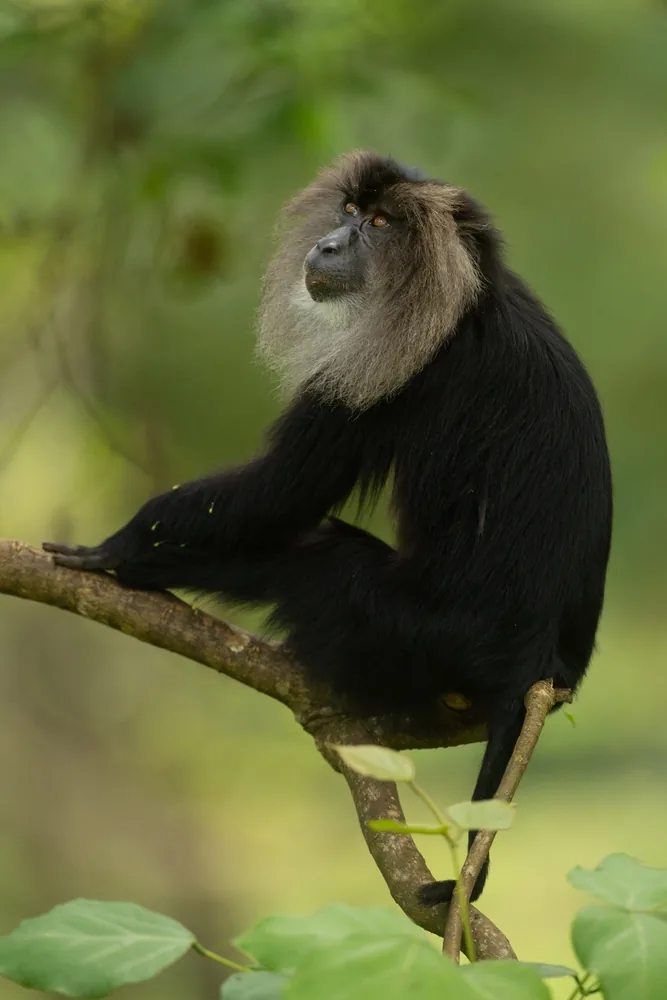
Periyar Tiger Reserve is Kerala's most celebrated wildlife destination and one of South India's most iconic protected areas - a 925 sq. km expanse of tropical forest in the Cardamom Hills of the Western Ghats built around the serene Periyar Lake, a reservoir created in 1895 by the construction of the Mullaperiyar Dam. The lake is the reserve's greatest feature: boat safaris on its still, emerald waters offer unforgettable encounters with herds of Asian elephants wading in, tigers emerging at dusk, and gaur standing at the waterline against a backdrop of mist-shrouded hills. Periyar shelters 35 Bengal tigers, over 900 Asian elephants, wild dogs, leopards, lion-tailed macaques, Nilgiri langurs, sambar, and over 266 bird species. The reserve forms a critical watershed for the Periyar and Pamba rivers - two of Kerala's most important rivers. Periyar is also an example of highly successful community conservation, with reformed poachers trained as wildlife guides through the Eco Development Committees. The reserve is part of the Nilgiri Biosphere Reserve and the Agasthyamalai Biosphere Reserve complex.
7. Parambikulam Tiger Reserve
Palakkad District, Kerala
Area: 643.66 sq. km
Established: 1973 (Sanctuary); 2010 (Tiger Reserve)
Parambikulam Tiger Reserve is Kerala's second tiger reserve and one of the finest examples of conservation in South India, nestled between the Anamalai Hills of Tamil Nadu and the Nelliampathy Hills of Kerala in Palakkad district. Covering 643.66 sq. km, it was declared a tiger reserve in 2010 and forms part of the UNESCO World Heritage-affiliated Western Ghats, Anamalai Sub-Cluster. The reserve is home to four indigenous tribal communities - the Kadar, Malasar, Muduvar, and Mala Malasar - who live within its forests and actively participate in eco-tourism, research, and conservation as guides and trackers. Among Parambikulam's most extraordinary residents is the Kannimara Teak - believed to be the world's oldest and tallest known living teak tree, estimated at over 450 years old. The reserve shelters Bengal tigers, leopards, Asian elephants, gaur, lion-tailed macaques, Nilgiri tahr, Nilgiri langurs, and over 268 bird species. The three reservoirs within the reserve - Parambikulam, Thunacadavu, and Peruvaripallam - add scenic richness and aquatic biodiversity.
8. Muthanga Wildlife Sanctuary (Wayanad Wildlife Sanctuary - Muthanga Range)
Wayanad District, Kerala
Area: 344 sq. km (full Wayanad WLS)
Established: 1973
Muthanga Wildlife Sanctuary is the popular name for the eastern Muthanga range of the Wayanad Wildlife Sanctuary, located in the Sulthan Bathery taluk of Wayanad district, Kerala. It is one of the most accessible wildlife safari destinations in Kerala, situated approximately 16 km from Sulthan Bathery town. The broader Wayanad Wildlife Sanctuary covers 344 sq. km across four hill ranges - Sulthan Bathery, Muthanga, Kurichiat, and Tholpetty - and forms a critical part of the Nilgiri Biosphere Reserve, connecting Karnataka's Nagarhole and Bandipur forests to Kerala's Wayanad district. The sanctuary shelters Bengal tigers, Asian elephants, gaur, leopards, dholes, sambar, spotted deer, barking deer, bonnet macaques, and king cobras. Muthanga offers half-day jeep safaris, and elephant sightings are particularly common near the forest borders in the early morning. The sanctuary's forests transition from moist deciduous to semi-evergreen and evergreen types, reflecting the climatic gradient of the Western Ghats. It is an important corridor in the largest contiguous wildlife landscape in South Asia.
9. Wayanad Wildlife Sanctuary
Wayanad District, Kerala
Area: 344 sq. km
Established: 1973
Wayanad Wildlife Sanctuary, established in 1973, is Kerala's second-largest wildlife sanctuary and an ecological keystone in the Nilgiri Biosphere Reserve - the first biosphere reserve established in India and one of the largest in South Asia. Stretching across the Western Ghats plateau of Wayanad district, the sanctuary's forests form an unbroken green arc connecting Karnataka's Nagarhole and Bandipur Tiger Reserves to Tamil Nadu's Mudumalai - making it one of the most vital wildlife corridors in India. The sanctuary is divided into four ranges: Muthanga, Tholpetty, Sulthan Bathery, and Kurichiat. Tholpetty in the north and Muthanga in the south are the main safari zones. The terrain is a mosaic of moist deciduous, semi-evergreen, and riverine forests. Wayanad shelters a significant population of Asiatic elephants - one of the highest-density elephant habitats in the world - along with Bengal tigers, leopards, dholes, gaur, giant flying squirrels, bonnet macaques, Malabar giant squirrels, and over 300 bird species. The sanctuary is integral to the genetic exchange of wildlife across the Western Ghats.
10. Mudumalai Tiger Reserve
Nilgiris District, Tamil Nadu
Area: 321 sq. km (core); 688.59 sq. km (total reserve)
Established: 1940 (Sanctuary); 2007 (Tiger Reserve)
Mudumalai Tiger Reserve holds a special place in Indian wildlife history - it was one of India's earliest declared wildlife sanctuaries (1940) and is among the most biodiverse corners of the Western Ghats. Located on the northwestern slopes of the Nilgiri Hills in the Nilgiris district of Tamil Nadu - the name translates as 'ancient hill ranges' - Mudumalai is a founding member of the five-state Nilgiri landscape, sharing boundaries with Bandipur (Karnataka), Wayanad (Kerala), and Sathyamangalam (Tamil Nadu). Covering 688.59 sq. km, the reserve's vegetation ranges from tropical moist deciduous forests and teak plantations to scrubland, bamboo groves, and Nilgiri shola. Mudumalai is famous for its spectacular elephant herds - it harbours one of the highest concentrations of wild Asian elephants in India, often seen crossing roads near Masinagudi and Bokkapuram. Bengal tigers, leopards, dholes, sloth bears, gaur, giant flying squirrels, and the Indian star tortoise are among its residents. Over 260 bird species have been recorded.
11. Sathyamangalam Tiger Reserve
Erode District, Tamil Nadu
Area: 1,411.6 sq. km
Established: 2011 (Tiger Reserve); 1976 (Wildlife Sanctuary)
Sathyamangalam Tiger Reserve, covering 1,411.6 sq. km in the Erode district of Tamil Nadu, occupies the critical ecological junction where the Western Ghats and Eastern Ghats meet - making it one of the most strategically important wildlife corridors in South India. Designated as India's 28th tiger reserve in 2013, its forests act as the essential bridge connecting the Nilgiri Biosphere Reserve to the east, linking Mudumalai, Wayanad, Bandipur, Nagarhole, and BRT Tiger Reserves into one giant, interconnected landscape. Sathyamangalam's forests are famously the territory where Veerappan, India's most notorious poacher and smuggler, operated for decades before his death in 2004 - a history that underscores just how severely these forests were once exploited. Since coming under Project Tiger protection, the reserve has seen a dramatic wildlife recovery. Today it shelters Bengal tigers, leopards, dholes, elephants, gaur, sloth bears, mugger crocodiles, Indian pangolins, and vultures. Over 245 bird species have been documented.
12. Anamalai Tiger Reserve (Indira Gandhi Wildlife Sanctuary)
Coimbatore & Tiruppur Districts, Tamil Nadu
Area: 958.59 sq. km
Established: 1976 (Sanctuary); 2008 (Tiger Reserve)
Anamalai Tiger Reserve - officially the Indira Gandhi Wildlife Sanctuary and National Park - is one of Tamil Nadu's finest and most ecologically rich protected areas, encompassing the breathtaking Anamalai (Elephant Hills) in the southern Western Ghats across the Coimbatore and Tiruppur districts. Covering 958.59 sq. km, the reserve was designated a tiger reserve in 2008 and forms part of the Parambikulam-Indira Gandhi tiger habitat complex, an interconnected landscape with an estimated metapopulation of 42 tigers spanning approximately 3,253 sq. km. The terrain ranges from tropical moist deciduous forests and grasslands at lower elevations to shola forests and montane grasslands at the heights of Anamudi. The reserve is home to the globally rare albino (white) gaur - found only here and in the adjacent Chinnar Wildlife Sanctuary. Lion-tailed macaques, Nilgiri tahr, Nilgiri langurs, Nilgiri marten, giant flying squirrels, elephants, tigers, and leopards share these forests. The Topslip area, with its forested hills and elephant camp, is the park's most visited destination.
13. Kalakad-Mundanthurai Tiger Reserve (KMTR)
Tirunelveli & Kanyakumari Districts, Tamil Nadu
Area: 895 sq. km
Established: 1988 (Tiger Reserve; Tamil Nadu's first)
Kalakad-Mundanthurai Tiger Reserve, established in 1988, holds the distinction of being Tamil Nadu's first tiger reserve and is one of the finest remaining examples of tropical wet evergreen forest in all of India. Located in the southern Western Ghats within the Tirunelveli and Kanyakumari districts, KMTR forms part of the Agasthyamalai Biosphere Reserve - recognised by the IUCN as one of the five most important plant diversity centres in India. The reserve is sometimes called the 'River Sanctuary' because 14 rivers originate within its boundaries, feeding countless agricultural tanks in the Tamil Nadu plains - making it an ecological and water security asset of incalculable value. The reserve's biodiversity is extraordinary: 150 endemic plant species, 448 endemic angiosperms, 77 mammal species including Bengal tigers, leopards, dholes, elephants, and over 273 bird species. Geological formations within the reserve - including porous rocks and undulating terrain - create unique micro-habitats. The adjacent Mundanthurai plateau and the lush Kalakad forests together make KMTR a botanist's paradise of unparalleled richness.
14. Srivilliputhur Megamalai Tiger Reserve
Virudhunagar & Theni Districts, Tamil Nadu
Area: 1,016.57 sq. km
Established: 2021 (India's 51st Tiger Reserve; Tamil Nadu's 5th)
Srivilliputhur Megamalai Tiger Reserve is the newest of Tamil Nadu's five tiger reserves, officially notified in February 2021 as India's 51st tiger reserve - formed by combining the Megamalai Wildlife Sanctuary and the Srivilliputhur Grizzled Giant Squirrel Wildlife Sanctuary. The combined reserve spans 1,016.57 sq. km across the Virudhunagar and Theni districts and is named partly after the rare grizzled giant squirrel - an endangered species endemic to India and Sri Lanka found in exceptional numbers in the Srivilliputhur sanctuary. The reserve plays a crucial connectivity role, bridging the Anamalai and Kalakad-Mundanthurai Tiger Reserves with the Periyar Tiger Reserve in Kerala - linking large stretches of the southern Western Ghats into a contiguous landscape. Three major rivers - the Vaigai, Suruliyaru, and Shanmuganathi - originate within the reserve. The forests shelter Bengal tigers, leopards, elephants, gaur, Nilgiri tahr, lion-tailed macaques, dholes, and over 250 bird species. The Megamalai highlands above 1,500 m are particularly rich in endemic fauna and flora.
15. Amrabad Tiger Reserve
Nagarkurnool & Nalgonda Districts, Telangana
Area: 2,611.4 sq. km
Established: 2014 (carved from Nagarjunasagar-Srisailam TR after Telangana's bifurcation)
Amrabad Tiger Reserve is India's second-largest tiger reserve by area, covering 2,611.4 sq. km of the Nallamala Hills in the Eastern Ghats of Telangana's Nagarkurnool and Nalgonda districts. It was created in 2014 from the northern portion of the Nagarjunasagar-Srisailam Tiger Reserve following the bifurcation of Andhra Pradesh and formation of Telangana. The reserve is characterised by rugged terrain - deep valleys, rocky gorges, dense deciduous forests, and plateaus - through which the Krishna River flows, feeding the massive Srisailam and Nagarjunasagar reservoirs. The Chenchu tribe, a Scheduled Tribe with a centuries-old forest-dwelling tradition and a unique symbiotic relationship with the forest, inhabit the reserve in significant numbers. Key wildlife includes Bengal tigers, leopards, Indian pangolins, dholes, sloth bears, mugger crocodiles, the threatened yellow-throated bulbul, and the star tortoise. The reserve is also under scrutiny following Telangana government proposals for uranium mining within its boundaries - a conservation concern that has attracted national attention and expert opposition.
16. Kawal Tiger Reserve
Adilabad & Nirmal Districts, Telangana
Area: 892.23 sq. km
Established: 1965 (Sanctuary); 2012 (Tiger Reserve)
Kawal Tiger Reserve, declared India's 41st tiger reserve in 2012, is located in the Adilabad and Nirmal districts of northern Telangana near the Maharashtra border - forming a critical wildlife corridor linking the tiger populations of Maharashtra's Tadoba-Andhari and Pench reserves to those of Telangana and Andhra Pradesh. Covering 892.23 sq. km of primarily dry teak and mixed deciduous forests within the Deccan ecosystem, the reserve is watered by the Godavari River and its tributaries. Despite having a low tiger density at present, Kawal is recognised by conservationists for its high potential as a future tiger source population zone, provided stepped-up protection is maintained. The forests shelter tigers, leopards, sloth bears, dholes, gaur, sambar, spotted deer, Indian wolves, chinkara, blackbuck, and over 200 bird species. The reserve is important for maintaining gene flow between central India's tiger landscapes and South India's forests - a corridor that has come under increasing pressure from infrastructure and agricultural expansion.
17. Nagarjunasagar-Srisailam Tiger Reserve
Nandyal, Palnadu & Prakasam Districts, Andhra Pradesh / Nalgonda & Mahbubnagar, Telangana
Area: 3,728 sq. km
Established: 1983 (India's largest tiger reserve)
Nagarjunasagar-Srisailam Tiger Reserve is India's largest tiger reserve by area - a vast 3,728 sq. km landscape spanning five districts across Andhra Pradesh and Telangana in the Nallamala Hills of the Eastern Ghats. The Krishna River cuts dramatically through the reserve, carving a gorge nearly 200 m deep over 130 km, creating one of the most spectacular natural landscapes in peninsular India. Within the reserve sit two of India's most powerful dams - the Srisailam Dam and the Nagarjunasagar Dam - and the sacred Srisailam Temple, one of Hinduism's 12 revered Jyotirlingas, stands majestically inside the forest. Several spectacular waterfalls - including Ethipothala, Pedda Dukudu, and Gundam - add to its scenic grandeur. The reserve shelters Bengal tigers, leopards, Indian pangolins, spotted deer, sambar, blackbuck, chinkara, chausingha, mugger crocodiles, and over 300 bird species. The Chenchu tribal community inhabits the core zone. The reserve has one of the largest critical tiger habitat areas in India.
18. Papikonda National Park
Polavaram & Eluru Districts, Andhra Pradesh
Area: 1,012.86 sq. km
Established: 1978 (Sanctuary); 2008 (National Park)
Papikonda National Park, located in the scenic Papi Hills of the Eastern Ghats along the Godavari River in Andhra Pradesh's Polavaram and Eluru districts, is one of South India's most visually spectacular national parks - and one of its most ecologically threatened. Covering 1,012.86 sq. km of moist and dry deciduous forests, the park was established as a wildlife sanctuary in 1978 and upgraded to a national park in November 2008. The Godavari River, one of India's most sacred and powerful rivers, flows through its core - threading between forested hills and creating dramatic gorges, natural embankments, and sandy islands that provide habitat for crocodiles, river otters, and rare freshwater turtles. Boat safaris on the Godavari are the park's signature wildlife experience, offering close sightings of riverine birds, otters, crocodiles, and forest wildlife approaching the banks. The park shelters tigers, leopards, Indian bison, sambar, spotted deer, wild boar, and over 200 bird species. The Polavaram irrigation project remains a significant conservation concern for the park's long-term future.